Dotty explorations
The diagrams on this page were developed almost entirely by Codex CLI, based on my input. The page uses a variety of tooling, including assorted Graphviz tools, Markdown, and SVG. Having created (much simpler) pages by hand, I am all too well aware of how much work this project would have been. Color me impressed…
Diagrams
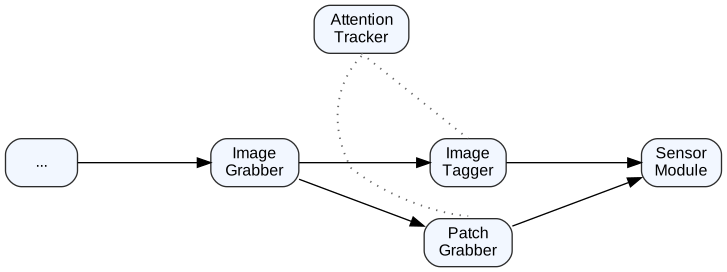
This diagram is based on some postings I made on the Thousand Brains Project (TBP) forum. It shows a possible architecture for image recognition, coupling an LLM-based “Image Tagger” to some Thousand Brains Theory (TBT)-based modules.
So, for example, the Image Tagger might tell the Attention Tracker that it recognized a coffee cup at a particular point in the image; the Patch Grabber would then grab a patch of pixels at that location and send it to the Sensor Module to be distributed to Monty’s Learning Modules.
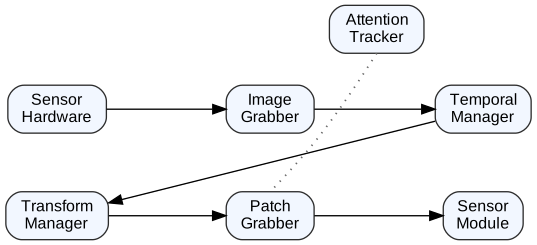
This diagram extends the Patch Grabber data flow. The idea is that the Temporal Manager would handle when the image was seen and the Transform Manager would perform desired transformations:
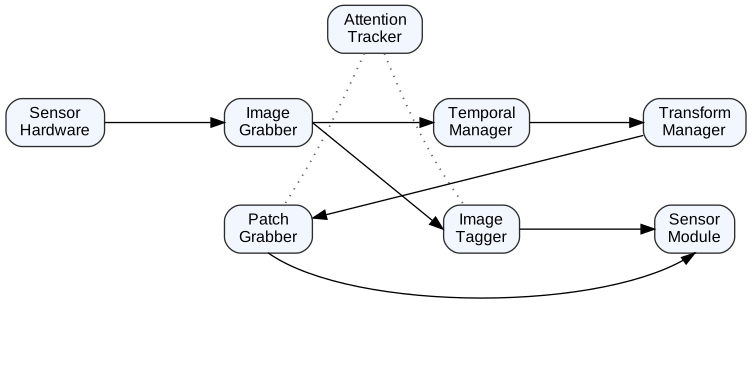
Putting it all together, here is the full diagram:
Discussion
Graphviz is a very capable diagram generation suite, but its syntax is a bit arcane and crafting complex diagrams can be tricky. So, I used Codex CLI to generate the diagram description files in SVG. And, because the result wasn’t displaying well, I had Codex CLI generate an editing script to fix things up:
patch-example-svg.pypost‑processes the generatedexample.svgdiagram to correct a specific curved edge (Patch Grabber → Sensor Module) that Graphviz can’t consistently render via DOT alone. It adjusts the spline curvature, ensures the arrowhead is visible and correctly oriented, and expands the SVG viewBox/height to prevent clipping. This keeps the final diagram visually consistent without hand‑editing the SVG each time.